Insurance business, made smarter, from one connected suite
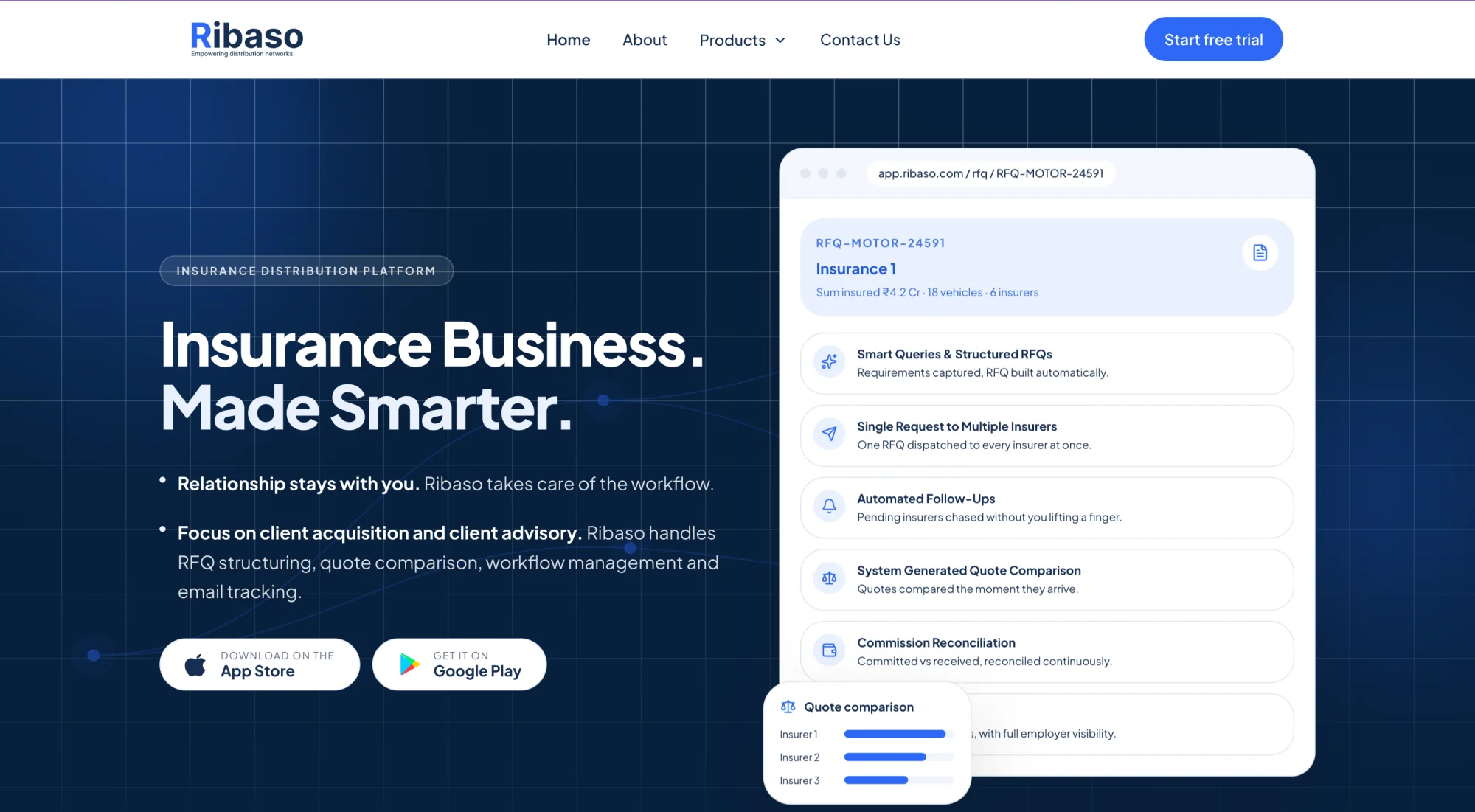
Ribaso is an insurance technology company, a B2B SaaS business building software for distribution-led businesses, starting with insurance. It has four products: Ribaso Insurance, its flagship platform for agents, brokers, and insurance professionals, plus R Connect for branded customer meetings, R-Team for team communication and tasks, and Webmail for business email. Insurance is the primary focus. I designed all four products, which Ribaso calls its suite, leading the 0→1 product design across web, desktop, iOS, and Android and defining the core journeys, the information architecture, and the interaction patterns the rest of the suite now builds on.
View LiveInsurance agents and brokers were switching across multiple disconnected portals just to structure an RFQ, request quotes from insurers, and track responses, the relationship was theirs, but the workflow around it was fractured.
Lead product designer on the 0→1 build of the Ribaso suite, all four products, defining core user journeys, information architecture, and interaction patterns across every platform the suite ships on.
- Mapped the full RFQ-to-policy lifecycle to find where agents were losing time to manual coordination.
- Designed a single request flow that dispatches structured RFQs to multiple insurers at once, with automated follow-ups replacing manual chasing.
- Designed the three other products in the suite, R Connect, R-Team, and Webmail, as standalone products that also plug into Ribaso Insurance through one shared directory, calendar, and file.
- Built the cross-platform design system, web, desktop, and native mobile, so the interaction patterns stay identical everywhere the suite runs.
The Ribaso suite is live: Ribaso Insurance handles RFQ structuring, multi-insurer quote comparison, and commission reconciliation in one workflow, with R Connect, R-Team, and Webmail alongside it, and the agent-client relationship staying fully with the agent.
The core positioning, "relationship stays with you, Ribaso takes care of the workflow", came directly out of early agent interviews about what they'd actually trust a platform to automate.
An insurance technology company with four products
Ribaso is not a single insurance tool. It is a B2B SaaS company that builds software for distribution-led businesses, starting with insurance. It is not an insurer, an aggregator, or an intermediary, and it is paid for the technology, not for commissions or business outcomes. That stance is the same rule that shaped every design decision in this case study: automate the workflow, stay out of the relationship.
Source: ribaso.com, About and product pages| Product | What it does | Role in the suite |
|---|---|---|
| Ribaso Insurance | Structured RFQs, one request to multiple insurers, automated follow-ups, quote comparison, commission reconciliation, and team monitoring, for agents, brokers, and insurance professionals. | Flagship and primary product |
| R Connect | Branded customer meetings: the company's logo and colours from invite to room, guests join without an account, with host controls and consent-based recording. | Standalone product, the client-facing room |
| R-Team | Direct and group chat, hierarchy-based tasks, and one shared activity feed. | Standalone product, how the agency talks |
| Webmail | Business email on the organisation's own domain, with an admin console, calendar, and tasks. | Standalone product, the mailbox every seat owns |
Insurance is the primary focus. Ribaso Insurance is the company's first platform, and R Connect, R-Team, and Webmail are standalone products that also plug into it, sharing one directory, one calendar, and one file. The company's stated ambition is to become the technology backbone for distribution-led businesses across industries, starting with insurance. I designed all four, and together they are what Ribaso calls its suite. This case study goes deepest on Ribaso Insurance, the primary product.
Scattered portals, one relationship, zero visibility
Insurance agents and brokers weren't struggling to find clients, that relationship was theirs and strong. What was broken was everything after the first conversation: structuring a request for quote, sending it to multiple insurers, chasing responses, comparing what came back, and reconciling commission at the end. Each of those steps often lived in a different tool, or in email threads and spreadsheets nobody else could see.
Evidence: discovery interviews with working agents and brokersThe early interviews weren't there to confirm the workflow was messy, that part was obvious within the first conversation. They were there to find the line agents actually cared about, and that line turned out to be narrower than expected: agents were happy to hand off coordination work, but visibly uneasy the moment a proposed feature touched anything that looked like the client relationship itself.
Agents didn't want a smarter portal, they wanted the coordination grind gone: chasing insurers, comparing formats, reconciling commission by hand. But the instant a feature looked like it was inserting itself between them and their client, trust dropped. Speed was welcome. Mediation was not.
That distinction, automate the workflow but stay out of the relationship, became the one rule every subsequent design decision had to survive.
| Stage | Before | After |
|---|---|---|
| RFQ creation | Manually typed per insurer, inconsistent formats | Structured RFQs captured once, built automatically |
| Insurer outreach | Separate emails or portals per insurer | One request dispatched to every insurer at once |
| Follow-ups | Manually tracked and chased | Automated follow-ups for pending insurers |
| Quote comparison | Manually compiled across formats | System-generated comparison as quotes arrive |
| Commission | Reconciled manually, error-prone | Committed vs. received tracked continuously |
What we chose to automate, and what we deliberately left with the agent
The original workflow made an agent re-key the same request for every insurer, chase each one separately, and rebuild the comparison by hand once quotes trickled back. Given the interview finding above, the fix couldn't just be a nicer version of that same shape, it had to remove the coordination work entirely while leaving the parts agents actually wanted to keep untouched.
This was the exact fragmented workflow agents were already frustrated with, just moved into cleaner software. It would have shipped the old problem with a better interface.
Matches what the interviews actually asked for: remove the repetition, not relocate it. The agent fills out the request once and it reaches every insurer simultaneously.
The same test applied to follow-ups. A simple notification when an insurer responded would have been easy to build, but it still left the agent responsible for noticing who hadn't answered, which is the exact tracking burden the interviews flagged as the real cost, not the RFQ itself. We designed the system to chase non-responsive insurers on its own and surface status, not busywork, to the agent.
One RFQ, every insurer. Instead of re-keying the same request per insurer, agents fill it out once and it dispatches everywhere simultaneously.
The system chases, not the agent. Automated follow-ups for non-responsive insurers remove the manual tracking work that used to eat into client-facing time.
Comparison as data arrives, not after. Quotes are compared the moment they come in rather than compiled retrospectively at the end of a quoting cycle.
Component patterns, live on ribaso.com
None of the decisions above hold up if an agent can't act on them while juggling several live quotes at once, so the visual system had to support fast scanning under real workload, not just look clean in a deck. The interface runs a dark, data-dense visual language, high-contrast panels, a single accent blue, and consistent card patterns across web, desktop, and mobile. These are the live production patterns; hover any of them.
What shipped
The Ribaso suite is live. Ribaso Insurance handles RFQ structuring, multi-insurer distribution, automated follow-ups, quote comparison, and commission reconciliation in one place, available on web, desktop, and native mobile, with R Connect, R-Team, and Webmail alongside it. The suite is still growing, this was the 0→1 foundation, not a finished endpoint. What changed isn't just that five separate steps got faster, it's that they stopped requiring five separate tools and, for the agent, five separate context switches per client.
What I can and cannot claim. As an active, still-growing 0→1 suite, I don't have an audited long-term metrics baseline to cite here. What I can point to is qualitative and structural: reduced context switching for agents, a single workflow replacing several disconnected ones, and interaction patterns now reused across every platform the suite ships on. Not measured percentage lifts.
What I'd do differently
Instrument usage analytics from day one of the 0→1 build, not after initial launch, for a product this workflow-dense, knowing exactly which step agents abandon first would sharpen every iteration that follows.