What happens after a vibe-coded site "just works"
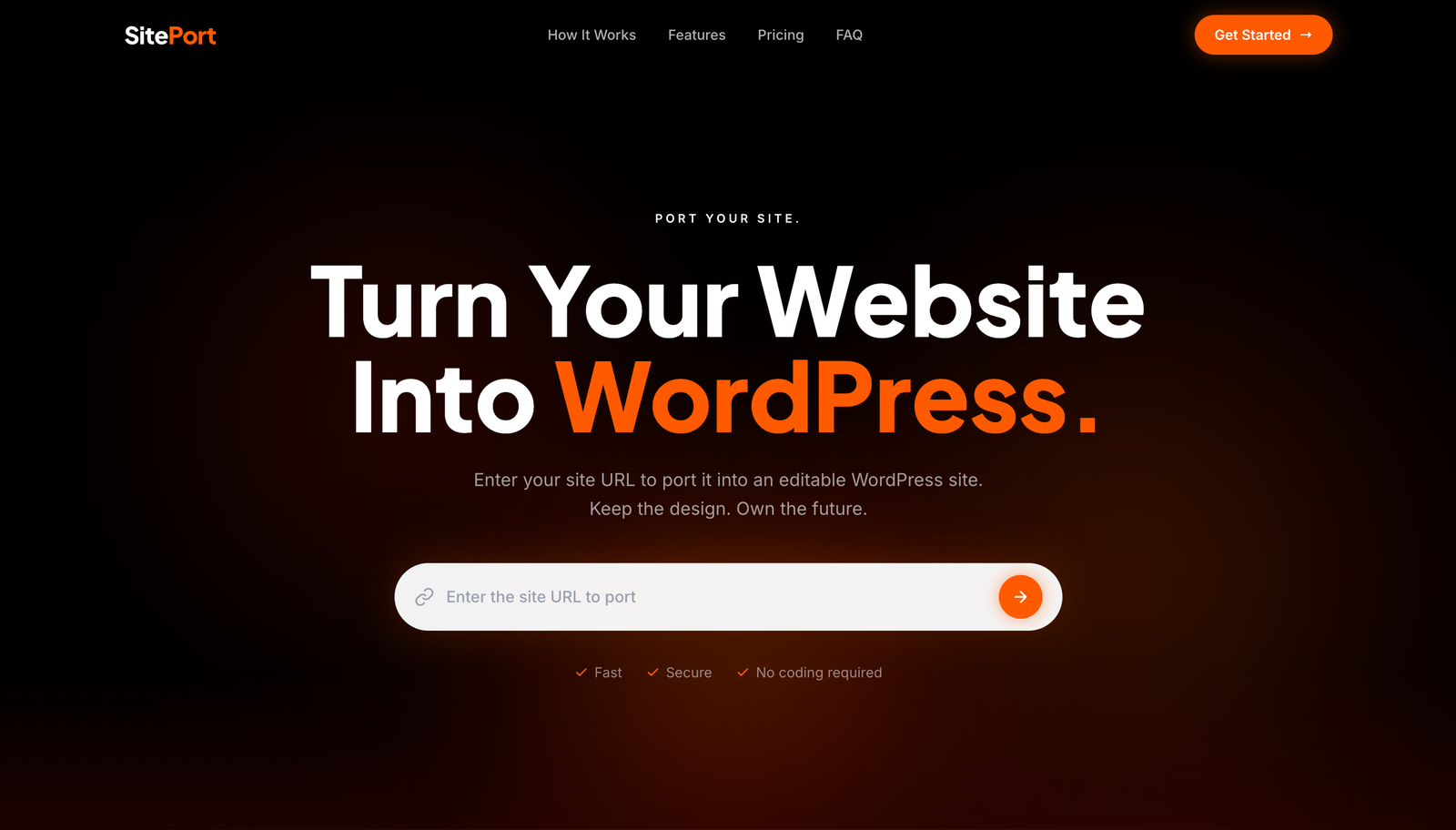
SitePort is a self-initiated project, not client work. It came out of watching people, myself included, hit the same wall after building something with Lovable: the site works, it looks good, but it's locked to a platform nobody but that AI tool can meaningfully edit. I designed and built a converter that turns an AI-generated site into a real, editable WordPress theme, so ownership doesn't have to stop where the AI tool's plan does. It's in the final stretch now, ahead of opening it up.
AI site builders like Lovable get someone from idea to a working site fast. But once it exists, editing it means going back into that same AI tool, or hiring a developer. There's no handoff to the platforms most freelancers, agencies, and small businesses already know how to run day to day.
Solo designer and builder. I chose which platform to convert into, decided how much visual fidelity was non-negotiable, and built the conversion pipeline and its interface myself.
- Chose WordPress and Elementor as the conversion target over a custom CMS, because it's the platform most non-technical owners and agencies already know how to operate, not because it's the most flexible option on paper.
- Designed the conversion flow around one non-negotiable: the output has to look identical to the original, since visual trust is what makes someone comfortable handing a converted site to a client.
- Built the analyze, convert, optimize pipeline and used Playwright to verify converted pages actually render and function correctly, not just visually resemble a screenshot.
A working converter that takes a Lovable site URL, or an uploaded codebase, and returns a theme that's genuinely editable in Elementor, not a static export dressed up to look editable.
The decision to treat design fidelity as a hard requirement came from testing an early version that quietly shifted spacing on conversion. Testers didn't file that as a bug, they just stopped trusting the tool.
A finished AI site is still someone else's platform
Lovable, and tools like it, solve the hardest part of starting: getting from a blank page to something real. What they don't solve is what comes after. The site you end up with is genuinely good, but it lives inside that tool's editor, its hosting, its constraints. If you want to add a blog, wire up an integration the AI tool doesn't support, or simply hand the site to a client who needs to update it themselves, you're stuck going back to the same AI prompt loop, or paying a developer to rebuild what already exists.
That gap mattered to me specifically because I work across both worlds, fast AI-assisted prototyping and real client delivery. I kept seeing good, fast, disposable work on one side and durable, ownable, editable work on the other, with no bridge between them.
Evidence: watching my own and other builders' Lovable projects hit the same wall after launchThe pattern showed up every time the same way: someone would finish a Lovable build, be genuinely happy with it, and then ask the same question a week or two later, how do I add a blog, or hand this to someone who isn't me. The AI tool that got them there had no good answer, because it was never built to be handed off.
The problem wasn't the quality of what AI site builders produce, it was that a finished AI-generated site had no path to becoming a maintained, editable product. SitePort is that path: it doesn't try to be a better site builder, it tries to hand back the thing a finished site actually needs to survive past its first version, ownership.
What I chose to prioritize, and what I traded away
Every decision here came down to the same tension: preserve the speed advantage of vibe coding without inheriting its throwaway nature.
Elementor over a custom builder. Less novel, less flexible on paper, but it's the editor freelancers and agencies already know, which is the entire point: adoption over architecture purity.
Visual fidelity as the hard requirement. Some complex AI-built interactions don't map cleanly to Elementor's widget model. I chose to flag what can't convert cleanly rather than silently drop it or fake it, even though a flagged gap is a worse first impression than pretending everything worked.
Codebase upload as a fallback, not just URL scraping. Some Lovable sites gate content behind routes a URL crawl can't see, so the tool needed a second path in even though it made the input flow less simple.
Defeats the entire point of vibe coding's speed. The person would spend as long rebuilding as they did explaining the brief to the AI tool the first time.
Keeps the speed advantage of vibe coding while handing back the long-term ownership and editability it doesn't come with by default.
Built, verified, and getting ready to open up
SitePort takes a Lovable site, analyzes its structure, and converts it into a WordPress theme that's editable in Elementor's drag-and-drop interface, preserving the design and flagging anything it can't guarantee a clean conversion for. It's a working product I built end to end, it just hasn't opened its doors publicly yet. It's the piece I'd point to first when explaining how I think about the actual boundary between what AI tools are good at and what still needs a deliberate design decision on top.
A quick note on this one. SitePort hasn't launched publicly yet, so there's no external adoption or conversion-rate data to cite here. What's above describes what's been built and how the pipeline works, not measured outcomes at scale.